
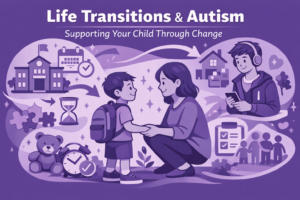
Life transitions and autism can feel overwhelming for both children and parents.
For families navigating life transitions and autism, even small changes can feel overwhelming without the right support.
Many families notice that things seem manageable until something changes. A new routine. A new school term. A different support worker. A move, even a small one.
Suddenly, behaviours escalate. Sleep becomes disrupted. Anxiety rises. Meltdowns happen more often.
Parents start asking themselves the same questions.
Why is this so hard for my child?
Why does every change feel like a setback?
How am I meant to prepare them when life keeps changing?
At Health Well Care, we work with families navigating these exact moments. And the most important thing to understand is this:
For many autistic children, transitions are not just changes. They can feel like a sudden loss of safety.
Why life transitions and autism are so closely connected
Transitions require flexibility, prediction, and emotional regulation.
For children with autism, these skills are still developing. Routines provide safety. Familiar environments reduce anxiety. Predictability helps the nervous system stay calm.
When something changes, the brain has to work harder to understand what is happening and what is expected next.
This can show up as:
- Increased meltdowns or shutdowns
- Regression in skills
- Refusal to leave the house
- Clinginess or withdrawal
- Sleep or eating difficulties
- Heightened sensory sensitivity
This is not stubbornness or manipulation. It is a stress response.
Common life transitions that trigger stress
Many parents are surprised by what their child reacts to.
Some of the most challenging transitions include:
- Starting or changing schools
- Moving house or rooms
- Changes to daily routines
- New support workers or teachers
- Puberty and developmental changes
- Moving toward greater independence
Even positive changes can feel unsafe if they are unexpected or poorly supported.
6 powerful ways life transitions and autism can be supported safely
While change cannot be avoided, it can be supported in ways that reduce distress and build confidence.
- Prepare early and clearly. Talk about changes well before they happen, using simple language and visual supports where possible.
- Break transitions into smaller steps. One change at a time is easier to manage than many at once.
- Keep familiar anchors. Maintain routines, objects, or activities that feel safe during periods of change.
- Validate emotions. Acknowledge fear or frustration rather than dismissing it. Feeling understood reduces escalation.
- Allow extra regulation time. Expect fatigue and emotional overload during transitions and adjust expectations.
- Use consistent, calm support. Predictable support helps the nervous system adapt.
Why transitions often affect the whole family
Parents often carry the emotional load quietly.
You may feel like you are constantly planning ahead, smoothing things over, or holding everything together so your child does not fall apart.
This can lead to burnout, guilt, and the feeling that you can never rest.
Support during life transitions is not just about the child. It is about keeping the family stable and supported too.
Life transitions and autism support with Health Well Care
Health Well Care provides NDIS support focused on life stages and transitions with calm, steady guidance.
With the right guidance, life transitions and autism do not have to mean constant stress or setbacks.
We work alongside families to:
- Reduce anxiety around upcoming changes
- Support emotional regulation during transitions
- Maintain daily routines where possible
- Build confidence and independence at a safe pace
- Provide consistent, respectful support
You can learn more about navigating NDIS supports through the official NDIS website, or explore practical autism resources via Raising Children Network.
Related Health Well Care supports include:
- Life Stages and Transitions
- Community, Social and Civic Participation
- Daily Living Skills and Innovative Participation
A note to parents
If transitions feel hard, it does not mean your child is failing.
It means their nervous system needs more support to feel safe.
With understanding, preparation, and the right NDIS support, many families find that transitions become calmer, more predictable, and less frightening over time.
Contact Health Well Care
Phone: 0449 207 681 or 0410 087 226
Email: [email protected]
Address: Level 2, Suites 1 & 2, 10A Atherton Rd, Oakleigh VIC 3166